 N環球

NVIDIA unveils GR00T 2, a robot foundation model that learns dexterous skills by watching human video
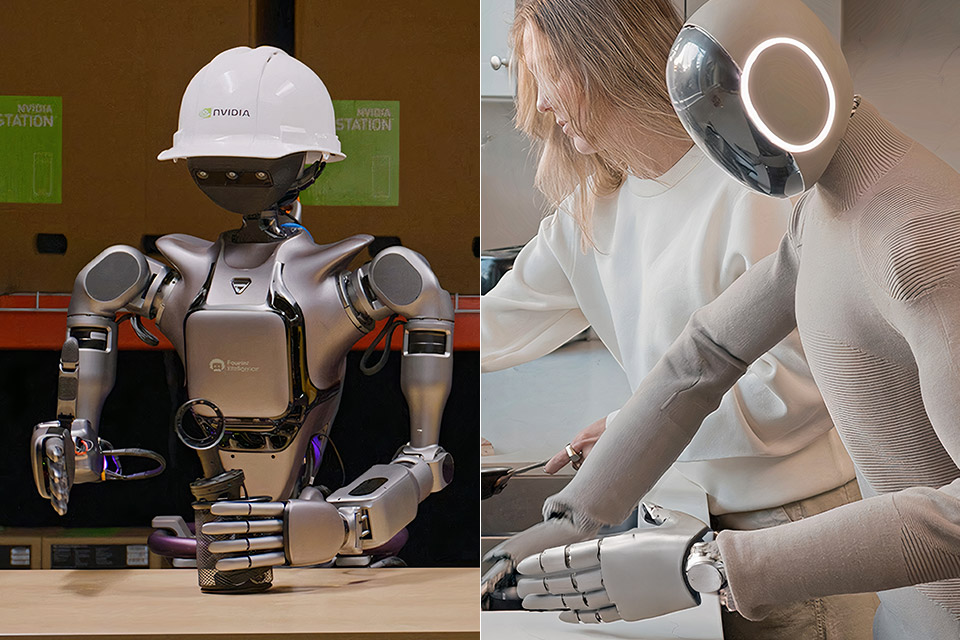
NVIDIA unveiled GR00T 2 on 9 November at the Conference on Robot Learning in Austin, Texas, a robot foundation model that learns dexterous manipulation largely from first-person human video and transfers skills across robot bodies; across 50 test tasks, average success reached 95% after five demonstrations — a figure from NVIDIA's own evaluation, on tasks selected for learnability.
NVIDIA unveiled its next-generation robot foundation model, GR00T 2, on 9 November at the Conference on Robot Learning (CoRL) in Austin, Texas, built around a simple idea: robots that learn by watching humans. The model takes first-person human video as its main training material, learns dexterous manipulation, and transfers the skill to robots of different shapes. NVIDIA also introduced GR00T 2 Turbo, a streamlined variant, and Isaac Lab 3.0, its robot training framework.
Predicting the scene and the action together
GR00T 2 is what NVIDIA calls a "world action model", built on its Cosmos family of world models. A single 2-billion-parameter diffusion transformer jointly predicts how a scene will change and which actions the robot should take, from recent video, a task instruction and the robot's current state. NVIDIA says the design lets the model understand the physics of a task before deciding how to act, rather than merely imitating motion trajectories.
Trained on 400,000 hours of human video; 95% success after five demonstrations
The training mix disclosed by NVIDIA includes 402,730 hours of first-person human video, 10,184 hours of handheld-gripper demonstrations and 23,500 hours of robot teleoperation; 100,000 hours of the human video have been released openly as the Human-1M-100K dataset under a Creative Commons CC BY 4.0 licence. NVIDIA's "X-Adapt" cross-embodiment transfer moves skills learned on one robot or from a human to a different robot, including gripper arms, dexterous hands and the Unitree G1 humanoid.
On 50 dexterous manipulation tasks (Dexter-50, on a bimanual robot with two 22-degree-of-freedom Sharpa hands), GR00T 2 averaged 40% success with no demonstrations on the target robot — completing 40 of the 50 tasks at least once — rising to 71% with one demonstration per task and 95% with five demonstrations plus a 30-minute fine-tune on a single RTX 5090 graphics card.
The 95% figure needs discounting; model code arrives in December
The 95% is not a field-reliability figure: NVIDIA's white paper discloses that the 50 test tasks were chosen among those the model learns with five demonstrations (at least 80% success), so the number carries a selection condition; all results are NVIDIA's own evaluation, with no independent replication published. Partners named by NVIDIA — Foxconn, Siemens and Nexuni — are at the testing or evaluation stage.
The "open" label is also partial: the 100,000-hour dataset is genuinely open, but the model's code is not due until December, and NVIDIA has announced no release date or licence for the model weights; Isaac Lab 3.0 is generally available. Sources: NVIDIA blog, NVIDIA research page, The Robot Report, 9 November 2026; The Neuron, alfw.ai, 10 November 2026.
💬 Comments
No comments yet. Be the first!