 N環球

Russian 'Double-Tap' Bombing of Ukraine Aid Centre Kills at Least 55 as Rescue Enters Seventh Day
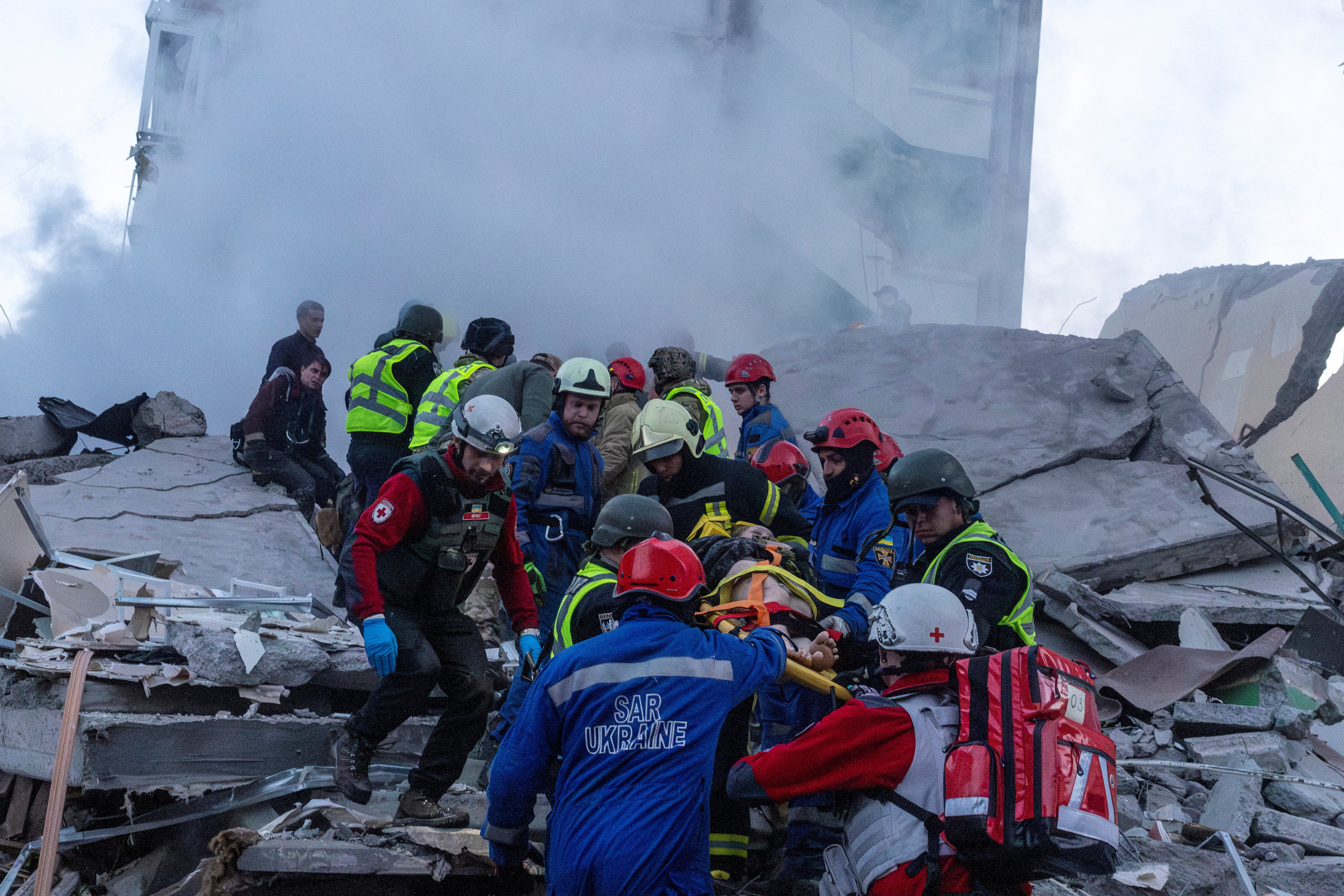
Russian forces bombed a school used to distribute humanitarian aid in the village of Komyshuvakha in Ukraine's Zaporizhzhia region on November 2; the death toll remains 55, with the search in its seventh day and dozens still missing; on November 8 a Russian drone struck the rescue site again, damaging equipment but injuring no one; Ukraine's military intelligence named the colonel and six Su-34 pilots behind the strike.
Russian forces bombed a school used to distribute humanitarian aid in the village of Komyshuvakha in Ukraine's southeastern Zaporizhzhia region on November 2, killing at least 55 people. The search entered its sixth day on November 7, with dozens of people still missing. Ukraine's military intelligence directorate named the Russian colonel who planned the strike and six Su-34 pilots who dropped the guided bombs, including a three-tonne FAB-3000. Two rescue workers and four police officers are among the dead; five people were injured. (Sources: Ukraine's State Emergency Service, AFP / Associated Press, Ukraine's Defence Intelligence Directorate.)
School struck first, then nine more bombs on the shelter
President Volodymyr Zelenskyy, writing on Telegram, said Russian forces first dropped aerial bombs on the school, then launched a repeat strike with nine more bombs directly on the shelter where people had gathered. "The Russians could not have been unaware that every week residents who have remained in Komyshuvakha were receiving assistance right there," he wrote. Footage posted by Ukraine's emergency services showed a building reduced to piles of smouldering rubble, with rescuers still searching for people believed trapped. The death toll was initially reported as 18, then revised to 24, and raised again to 26 in Zelenskyy's nightly address, and could rise further.
A day after a local ceasefire expired
The attack came a day after the expiry of a six-day local ceasefire brokered by U.S. First Lady Melania Trump to bring aid into the embattled city of Oleshky in the Kherson region to the southwest and evacuate residents wishing to leave. Zelenskyy said the attack was "further proof that Russia does not want any kind of de-escalation, any real justice." Russia has consistently denied targeting civilian targets. Komyshuvakha lies southeast of the regional capital, also called Zaporizhzhia.
Update
Update (November 3 morning): Zaporizhzhia regional authorities and Ukraine's State Emergency Service revised the figures: the death toll rose from 26 to 29 and the number of missing from 27 to 48; five people remain injured. Zaporizhzhia region declared November 3 a day of mourning, rescue work continues, and overnight rescue efforts were at times disrupted by Russian drone attacks.
Update (November 3): Mykhailo Semikin, acting head of the Zaporizhzhia regional military administration, said on national television that the death toll had risen from 29 to 31, with almost 50 people still missing. Russia's Defence Ministry said on November 3 that the strikes had targeted Ukrainian military units in and around Komyshuvakha, claiming up to 25 Ukrainian servicemen killed. Search and rescue work continues, and the toll may rise further.
Update (November 3 evening): Mykhailo Semikin updated the figures again in the evening: the death toll remains 31, of whom 20 have yet to be identified; the number missing has risen from almost 50 to 58, and five injured people remain in medical care. Latvian Foreign Minister Baiba Braze announced that Latvia has sought an emergency meeting of the UN Security Council over the attack. Search-and-rescue work continues and the death toll may still rise.
Update (November 3, Zelenskyy statement): President Volodymyr Zelenskyy said the death toll had risen to at least 33, with more than 50 people possibly still trapped under the rubble. Regional authorities had previously reported 31 dead and 58 missing, a slightly different count; search work continues and the final toll may still change. The UN Human Rights Monitoring Mission in Ukraine noted that the timing and location of the aid distribution were widely known, and said the attack appeared to breach fundamental principles of international humanitarian law. Russia's Defence Ministry maintained that its targets were Ukrainian military units.
Update (November 4): Reuters reported on November 4 that the death toll from the Komyshuvakha aid centre bombing has risen to 37, with rescuers still searching the rubble for survivors, according to Mykhailo Semikin, acting head of the Zaporizhzhia regional military administration. Ivan Fedorov, co-head of the Zaporizhzhia Regional Defense Council, wrote on Telegram that 59 people were missing. The dead include two rescue workers and four police officers. Russia's Defence Ministry said the strikes targeted Ukrainian military units around Komyshuvakha and two other settlements, claiming up to 25 Ukrainian servicemen were killed. Rescue work continues and the toll may rise further.
Sources: Reuters (2026-11-02), Ukraine's State Emergency Service, Volodymyr Zelenskyy on Telegram, Zaporizhzhia regional government; November 3 update (per Semikin on national television / Associated Press).
Update (November 4, evening): Reuters updated its report on November 4, putting the death toll from the Komyshuvakha aid centre bombing at 40, up from 37, with 59 people still missing, as rescuers keep searching the rubble for survivors. The dead include two rescue workers and four police officers. Russia's Defence Ministry said the strikes targeted Ukrainian military units around Komyshuvakha and two other settlements, claiming up to 25 Ukrainian servicemen killed. Search and rescue work continues, and the toll may rise further.
Update (November 5): Ukraine's national police released body-camera footage showing the interval between the Russian bomb strikes on the aid centre and the shelter in Komyshuvakha; BBC Verify confirmed the video was filmed at the same location as Ukrainian emergency service footage of the aftermath. President Volodymyr Zelenskyy said Russian forces dropped nine aerial bombs on the village, first striking people who had come for humanitarian aid and then the rescuers and police who arrived to help. Russia's Defence Ministry said its forces had targeted Ukrainian military units in the area and claimed up to 25 servicemen were killed; that claim has not been independently verified. The search entered a third day, with dozens still unaccounted for.
Update (November 5): Reuters reported on November 5 that the death toll from the Komyshuvakha aid centre bombing has risen to 42, police said, making it one of the deadliest strikes on civilians this year. Zaporizhzhia police said on Telegram that up to 33 people remained buried beneath the rubble, and that rescue work and efforts to identify the bodies were continuing. Ukraine's national police said the strikes included a 3-ton FAB glide bomb, a weapon defence intelligence websites say carries around 1.4 tons of explosives. Russia's Defence Ministry said the attack targeted Ukrainian military units around Komyshuvakha and two other settlements, and that up to 25 Ukrainian servicemen were killed. Rescue work continues and the death toll may still rise.
Update (November 6): Acting Zaporizhzhia Governor Mykhailo Semikin said on Telegram on November 6 that the death toll had risen to 53; Ukraine's State Emergency Service had earlier put the toll at 50. Search and rescue work has entered its fifth day and is continuing; the death toll may still rise.
Update (November 6): Yuliia Barysheva, spokesperson for Ukraine's State Emergency Service in Zaporizhzhia region, confirmed on November 6 that rescuers had recovered 53 bodies from the rubble, with around 50 people still listed as missing, as the search entered its fifth day. It is the deadliest Russian attack on Zaporizhzhia Oblast since the start of the full-scale invasion. The emergency service had earlier put the death toll at 50, while Governor Mykhailo Semikin said 53; the two counts have yet to converge, and the final toll may still change.
Update (November 7): The death toll from the bombing of the aid centre in Komyshuvakha has risen to 55, France 24 reported on November 7, citing the Associated Press, as the search entered its sixth day with dozens of people still missing. Ukraine's military intelligence agency (HUR) named the Russian colonel who planned the strike and six Su-34 pilots who dropped the guided bombs, including a 3,000-kilogram FAB-3000. Russia's Defence Ministry said the attack targeted Ukrainian military units around Komyshuvakha and two other settlements.
Update, November 8: Russian drone strikes rescue site again; Zelenskyy calls it 'absolute cynicism and brutality'
On Sunday, November 8, a Russian FPV drone struck the rescue site in Komyshuvakha, hitting emergency workers carrying out search and rescue operations and damaging specialised rescue equipment. No one was injured. Ukraine's State Emergency Service said the strike targeted the school used to distribute humanitarian aid and a nearby shelter, both destroyed in the November 2 airstrike. President Volodymyr Zelenskyy wrote on social media that deliberately striking the same location while rescuers were working there was 'absolute cynicism and brutality', adding that more people could still be trapped under the rubble. The death toll remains 55, with around 50 people still listed as missing, and the search in its seventh day. On Saturday, November 7, a farewell ceremony was held in Zaporizhzhia for six police officers killed in the attack, three of them near the school.
💬 Comments
No comments yet. Be the first!