 N環球

Ukraine Strikes Crimea Bridge for Second Day, Sending 227-Metre Road Arch Into Kerch Strait; Rail Resumes as Road Stays Shut
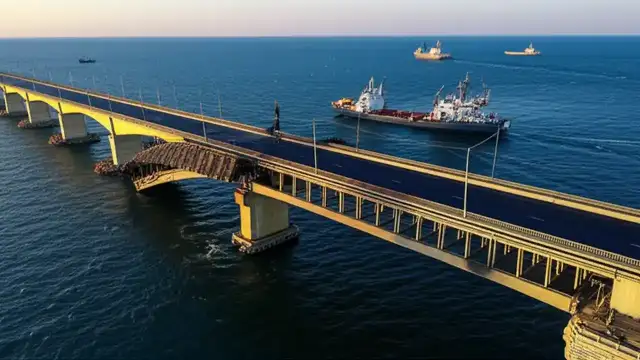
Ukraine struck the Crimean Bridge for a second day running, dropping about 273 metres of roadway and its steel arch into the Kerch Strait; road traffic remains shut while rail service resumed on the afternoon of November 17, Russia's Investigative Committee has opened a terrorism case, and casualty accounts still conflict.
Ukraine struck the Crimean Bridge (Kerch Bridge) for a second time in two days overnight on November 16-17, sending about 227 metres of road arch and the roadway beneath it into the Kerch Strait. Russia's Transport Ministry confirmed on Tuesday morning that road and rail traffic is fully suspended while specialists assess the damage; photos and video from several angles confirm the span has collapsed.
Two strikes in two days; the first already bent the arch
The first strike came at 05:38 on Monday, November 16, when a drone hit the steel arch over the road bridge's navigable span and bent it out of shape; the Kremlin initially described the damage as minor and limited traffic resumed. The second attack came in several waves overnight, with occupation authorities in Crimea issuing missile alerts at 00:56, 03:52 and 05:03 local time. Sergei Aksyonov, the Moscow-installed head of Crimea, confirmed the second attack at around 01:35 and urged people to stay away from the bridge. Photos taken from Kerch on Tuesday morning showed only the railway arch still standing over the channel; the road arch and its deck were gone.
Moscow: road and rail halted; casualty accounts differ
Russia's Transport Ministry said road and rail traffic is fully suspended and specialists are assessing the damage, adding that preliminary information indicated no casualties; Reuters later cited Aksyonov as saying two people were killed, and the casualty figures remain unreconciled. Russia's Investigative Committee has opened a terrorism case; the Kremlin has convened a government commission on the aftermath, led by Deputy Prime Minister Marat Khusnullin; Kremlin spokesman Dmitry Peskov promised the bridge would be rebuilt.
Zelenskyy: the seventh stage of an operation prepared over weeks
Ukrainian President Volodymyr Zelenskyy described the strike as the seventh stage of an operation prepared over several weeks, first clearing air defences and then hitting the bridge; Ukraine's Security Service (SBU) said the metal arch and the roadway beneath it were "completely destroyed". Zelenskyy named the weapons used: Palianytsia drones against the road section, Neptune missiles and Ruta and FP-5 drones against the rail section, and FP-5 Flamingo cruise missiles for precision strikes. Open-source analysts say at least four FP-5 missiles broke through the air defences guarding the bridge. Ukraine's General Staff confirmed the road arch and the adjoining span had collapsed into the water, leaving the road section completely out of service. The monitoring channel Crimean Wind said the wreckage blocked the Kerch-Yenikale Canal, the navigable passage between the Black Sea and the Sea of Azov; open-source trackers estimate repairs could take years.
Background: a 19-km bridge and a military lifeline
The Crimean Bridge is 19 kilometres long and cost $3.7 billion; opened by Russian President Vladimir Putin in 2018, it is the only fixed link between mainland Russia and occupied Crimea and the peninsula's main military supply artery. It was previously hit by a truck bomb in October 2022 and by sea drones in 2023; this is the fourth time the SBU has targeted the crossing.
On the same night, Russian missiles struck the Pivdennyi and Pivnichnyi bridges across the Dnipro River in Kyiv; both remain standing but are closed to traffic, and Kyiv's metro suspended the above-ground section of its green line.
(File photo: the damaged Crimean Bridge. Image: online file photo.)
Update, afternoon of November 17: rail service resumes; road stays shut
Rail traffic across the bridge resumed on the afternoon of November 17. Sergei Aksyonov, Crimea's Russian-installed head, announced that trains were running in both directions, and Reuters and the Associated Press confirmed that trains were crossing again. Russian carrier Grand Service Express said the Moscow–Kerch Tavria train No. 92/91 departed Taman station at 13:04 local time, with three more trains from St. Petersburg, Moscow and Adler to follow. Road traffic remains closed, and officials advised motorists wanting to cross the Kerch Strait to use ferries instead. Russia's Investigative Committee formally confirmed that the bridge's structures were damaged in the November 16–17 strikes and opened a criminal case under the article on a terrorist act, without specifying the extent of the damage. Kremlin spokesman Dmitry Peskov said Deputy Prime Minister Marat Khusnullin had briefed President Vladimir Putin and that a repair plan was being drawn up; the Kremlin said the bridge 'will be restored and will be even better than it was before.' The Kyiv Independent quoted experts as saying repairs to the road section could take more than a year. Casualty accounts still conflict: Russia's Transport Ministry said in its initial assessment that there were no casualties on the bridge, while Aksyonov said two people were killed in Crimea. The roughly 227-metre road arch fell into the Kerch–Yenikale canal, blocking the shipping channel between the Black Sea and the Sea of Azov. (Sources: Reuters; Associated Press; Interfax; Investigative Committee of the Russian Federation; The Kyiv Independent)
Latest: repairs could take more than a year
A Kyiv assessment published on Tuesday put the repair at a year or longer, not months, for a fallen structure weighing some 6,000 tonnes; David MacKenzie of engineering consultancy COWI likewise assessed that full restoration of car traffic would take more than a year. President Volodymyr Zelenskyy gave a weapon-by-weapon account the same day: Palianytsia drones struck the road section, Neptune missiles and Ruta and FP-5 drones struck the railway section, and a Flamingo cruise missile delivered the precision strike. Ukraine's Security Service confirmed that one metal arch and the roadway span beneath it were "completely destroyed", saying the operation lasted about a month and ran in seven stages. Kremlin spokesman Dmitry Peskov said the bridge "will be restored, and it will be even better than before"; Russia's Investigative Committee has opened a criminal case on terrorism charges. Casualty accounts still conflict: the Transport Ministry says no one was killed on the bridge, while Aksyonov says two people died in drone attacks on Crimea. Rail service resumed on Tuesday and the road remains closed; when the Kerch-Yenikale channel will reopen is still unclear.
Correction: fallen arch spans 227 metres; damage assessment complete
Multiple sources now confirm that the fallen road arch spans 227 metres (this site earlier wrote 273 metres; corrected). Russian Deputy Prime Minister Marat Khusnullin said the damage assessment is complete and the scope of construction work has been determined; Kremlin spokesman Dmitry Peskov repeated that the bridge "will be rebuilt, and it will be even better than before." No official Russian repair timeline has been announced; experts assess that restoring full road traffic will take more than a year. When the Kerch–Yenikale shipping channel will reopen remains unconfirmed. (Sources: Kyiv Independent; Reuters; Associated Press)
Update, November 18: the two deaths were not on the bridge; Kremlin vows to rebuild
Multiple outlets clarified on November 18 that the two deaths cited by Aksyonov were victims of a separate drone attack in the Leninsky district that same night, not deaths on the bridge; Russia's Transport Ministry said nobody was hurt on the bridge. Kremlin spokesman Dmitry Peskov said the bridge will definitely be rebuilt and a repair plan is being prepared; a government commission led by Deputy Prime Minister Marat Khusnullin has met to assess the damage. Rail traffic has resumed on a single track, the road remains closed, and no official repair timeline has been published; experts estimate full restoration of road traffic will take more than a year.
Update, evening of Nov. 18: experts put repairs at two years or more; channel still blocked
Ukraine's Defense Express estimates that rebuilding the fallen 227-metre arch will take at least two years and may not be completed before the war ends; an expert at engineering consultancy COWI also estimates that fully restoring road traffic will take more than a year. The fallen arch still blocks the Kerch–Yenikale canal — the only deep-water channel between the Black Sea and the Sea of Azov — and as of Nov. 18 Russia has published no reopening time or new navigational clearance. Kremlin spokesman Dmitry Peskov said the bridge would be rebuilt "better than before" but gave no date. (Sources: BBC; Defense Express.)
Nov 19 update: Bridge struck again overnight; traffic halted once more
Ukrainian forces struck the Crimean Bridge again just after midnight local time on Nov 19, less than two days after the Nov 17 attack sent the road arch into the Kerch Strait. Sergei Aksyonov, the Russian-installed head of Crimea, confirmed the bridge had been hit again, saying traffic was temporarily halted while services assessed the damage. The Kyiv Independent said the extent of the damage from the latest strike could not be independently verified. Russia has vowed to rebuild the bridge, but experts estimate a full repair will take more than a year. Rail traffic resumed on one track on Nov 17, according to the Russian Transport Ministry; the road remains closed, no official repair timetable has been published, and the fallen arch still blocks the Kerch–Yenikale shipping channel. (Sources: Kyiv Independent; Reuters)
Nov 19 morning update: Rail expected back by 4 p.m.; third strike in four days
The Associated Press reported on Nov 19 that this was the third attack on the bridge in four days, halting rail traffic again after the overnight strike. Sergei Aksyonov, the Moscow-appointed head of Crimea, said rail service was expected to resume from around 4 p.m. local time (1300 GMT) on Thursday while authorities assessed the damage from the latest strike. The road remains closed, the fallen 227-metre arch still blocks the Kerch–Yenikale canal, and experts estimate rebuilding the arch will take at least two years. (Source: The Associated Press)
💬 Comments
No comments yet. Be the first!